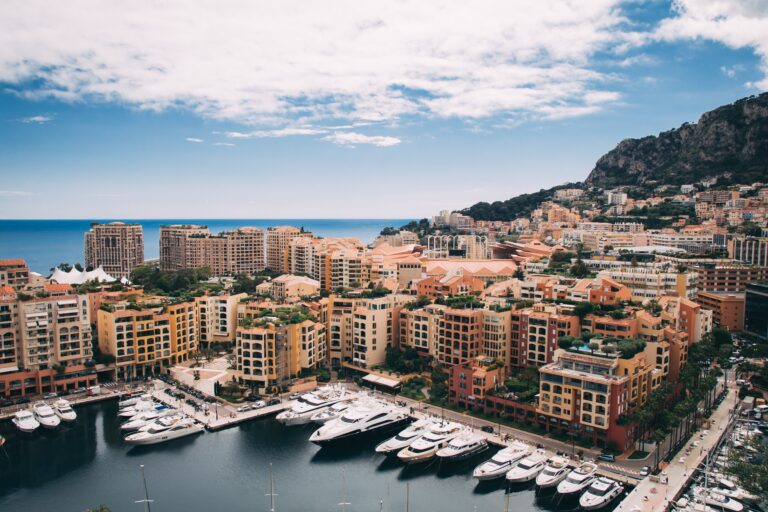
Monaco taxes at a glance
Monaco is famous for charging zero personal income tax. That part is real, and it has been the rule since 1869. But “Monaco taxes” is not the same as “no taxes”. The Principality still levies VAT, inheritance and gift duties on local assets, real estate transfer tax, a 1% leasehold tax, a tourist tax, and corporate income tax on companies with significant foreign revenue. French nationals living in Monaco are also subject to a separate bilateral regime.
This guide lays out every Monaco tax that applies in 2026, what is genuinely 0%, and where the practical burden sits for residents and businesses.
NEW REPORT
The report “The definitive guide to living in Monaco” is now available, with detailed information on Monaco’s tax framework, residence and society.
Click here to download it for free.
What Monaco residents do not pay
The Principality does not levy:
- Personal income tax, except for French nationals subject to the 1963 bilateral treaty (see below)
- Wealth tax
- Annual property tax or municipal tax
- Capital gains tax on securities, real estate or other assets
- Withholding tax on dividends or interest paid by Monaco-based companies
The exemption applies to Monaco nationals and to foreign residents who hold both administrative residency and a Monaco tax residency certificate. The certificate is what lets you assert tax residency to foreign authorities, so without it the income-tax advantage is not portable. Read more in our complete guide to Monaco income tax and our breakdown of whether Monaco is genuinely tax free.
Monaco taxes that do exist
Value Added Tax (20%)
Monaco is part of the French VAT system due to its EU customs status. The standard rate is 20%, applied to most goods and services on the same terms as France, with the same reduced rates and exemptions. Property transactions involving new buildings, building plots or significantly renovated properties also carry 20% VAT.
Real estate transfer tax
Older properties not classed as “new buildings” are subject to transfer duties instead of VAT:
- 4.75% if the buyer is a private individual or a qualifying Monegasque Personal Civil Company (SCP)
- 7.5% for non-transparent structures (foreign companies, Monaco corporations, trusts) that comply with beneficial-ownership disclosure
- Up to 10% for non-transparent entities that fail to provide proper beneficial-ownership documentation
Notary fees apply on top.
Leasehold tax (1%)
Monaco does not have an annual property tax, but it levies a 1% leasehold tax on the rent of residential housing. The tax is paid by the tenant on registration of the tenancy agreement, not by the landlord. Failure to register on time can result in penalties.
Inheritance and gift tax
Inheritance and gift tax apply only to assets located in Monaco, regardless of the deceased’s domicile or nationality. Rates depend on the relationship to the heir:
- Spouse and direct beneficiary: 0%
- Partners under civil union: 4%
- Sibling: 8%
- Uncle, aunt, nephew, niece: 10%
- Other relative: 13%
- Unrelated beneficiary: 16%
Exemptions apply to transfers to certain charitable institutions or to the Principality. Full breakdown in our guide to Monaco inheritance tax.
Tourist tax
Since January 2024, non-resident visitors over 18 pay a contribution touristique on hotel stays. Rates run from [currency amount=”2″ cur=”EUR”] per person per night in 2-star hotels to [currency amount=”7″ cur=”EUR”] in 5-star hotels. Stays exceeding 90 consecutive days are exempt. The tax does not currently apply to short-term furnished rentals such as Airbnb.
Other duties
Monaco also levies registration fees, stamp taxes, business licence tax, social-security contributions for employers, and excise duties on alcohol and tobacco. None of these are large for a private individual but they exist.
Corporate tax: 25% over a foreign-revenue threshold
Monaco does levy corporate income tax (Impôt sur les Bénéfices). It applies to industrial or commercial companies that generate more than 25% of their revenue outside the Principality, at a standard rate of 25% (reduced from 33.33% in 2022). Companies earning 75% or more of their revenue inside Monaco are exempt entirely.
New companies meeting the criteria still benefit from a graduated relief scheme:
- Years 1-2: full exemption (0%)
- Year 3: 6.25% effective rate
- Year 4: 12.5% effective rate
- Year 5: 18.75% effective rate
- Year 6 onward: full 25%
There are no withholding taxes on dividends or interest paid by Monaco-based companies. Read the full breakdown in our guide to Monaco corporate tax.
The hidden cost: foreign withholding tax
Personal income tax in Monaco is 0%, but the Principality has full double taxation treaties with only ten jurisdictions: France, Guernsey, Liechtenstein, Luxembourg, Mali, Malta, Mauritius, Qatar, Saint Kitts and Nevis, and Seychelles. Without a treaty, foreign-sourced dividends face local withholding tax that cannot be reclaimed.
For investors, this means 30% withholding on US-source dividends and 35% on Swiss-source dividends, with no recovery — versus 15% under treaties enjoyed by French or UK residents. A portfolio investor with heavy US or Swiss equity exposure can end up paying more total tax in Monaco than at home, despite the headline 0% income tax.
French nationals: the 1963 treaty
Under the Franco-Monegasque tax convention of 1963, French nationals who established Monaco residency after October 13, 1957 remain subject to French income tax on worldwide income as if they still lived in France. This includes salary, dividends, interest, capital gains and business income.
Exemptions exist for French nationals who established residency in Monaco before October 13, 1957, those born and continuously resident in Monaco, Monegasque nationals, and spouses of Monegasque nationals. For everyone else with a French passport, Monaco is not a tax-free destination at all. Our guide to Monaco taxes for foreigners covers the exceptions in detail.
Is Monaco a tax haven?
Not according to the OECD or the EU. Monaco was on tax-haven blacklists for decades because of banking secrecy, but the Principality was removed from the OECD list in April 2009 and has since signed the Common Reporting Standard, the BEPS framework, and (in October 2025) an updated CRS 2.0 protocol with the EU. The OECD currently rates Monaco “Compliant” on tax-information exchange.
The FATF placed Monaco on its grey list in June 2024 over money-laundering monitoring, with the Principality targeting an exit by January 2026. This is separate from tax-haven status. For more on the distinction read is Monaco really a tax haven.
Becoming a Monaco tax resident
To benefit from the zero personal income tax, you need both administrative residency (Carte de Séjour) and a Monaco tax residency certificate. Administrative residency typically requires a Monegasque bank deposit (often around [currency amount=”500000″ cur=”EUR”]), accommodation in the Principality, and a clean criminal record. The full process is in our Monaco residency guide.
Tax residency is a separate step requiring more than 183 days per year in Monaco (or having your centre of economic interests there) and a formal certificate from the Monaco tax administration. Read the requirements in our tax residency guide.
Thinking of Monaco?
Monaco Relocation Group has been guiding entrepreneurs, high-net-worth individuals, athletes and crypto investors through the Monaco residency process for years. If you want a personal assessment of whether Monaco fits your tax profile, contact us at [email protected] or through our contact page.
You can also download our free report “The Definitive Guide to Living and Paying Taxes in Monaco” below for the full framework, residency requirements and lifestyle considerations.
Sources

 All communications are encrypted and will be treated with absolute confidentiality. Your data will never be shared with third parties.