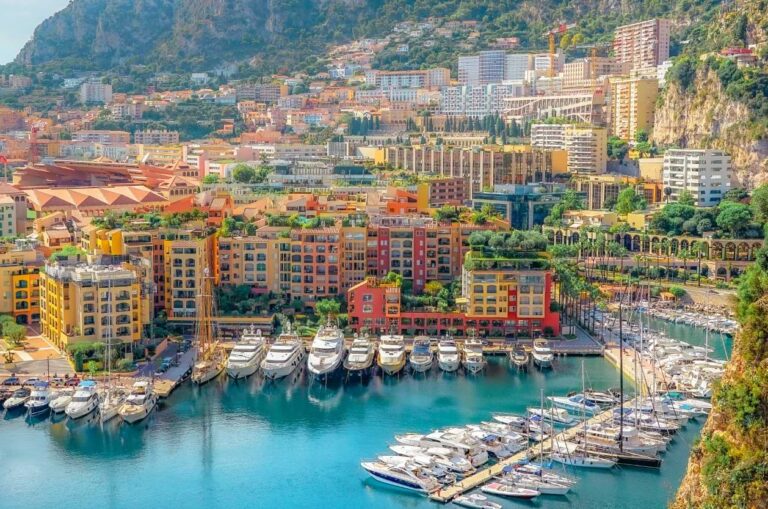
Monaco is often described as a place where people pay no taxes at all and which still operates as a sheltered tax haven in the middle of Europe. Neither claim holds up to scrutiny. Monaco was removed from international tax-haven blacklists more than a decade ago, and several taxes do apply within its territory.
This guide explains what “tax haven” actually means under modern definitions, why Monaco no longer qualifies, what taxes the Principality does levy, and how to become a Monaco tax resident.
What is a tax haven?
The term “tax haven” does not mean a country with low or zero taxes. The modern definition, used by the OECD and the EU, focuses on transparency and the exchange of financial and tax information.
A true tax haven is a jurisdiction that does not exchange tax information with other countries and does not have double taxation agreements with information-exchange clauses. Strict banking secrecy and refusal to share taxpayer data with foreign authorities are the defining characteristics, not the absence of tax. That is why jurisdictions with zero taxation such as the UAE or Qatar are not currently classified as tax havens, while countries like Panama or Fiji are.
A country can only be officially called a tax haven when a relevant authority (a major economy or a supranational body) places it on a non-cooperative list. There are three types of lists in practice:
- National lists, established by individual countries to decide which jurisdictions to treat as tax havens.
- Supranational lists from organizations such as the OECD or the EU, with major banking and business implications.
- NGO and UN lists, more useful as a thermometer of public perception than as legal classification.
Monaco was on national and international tax-haven lists for decades because of banking secrecy and the lack of information sharing. That has now changed.

Why Monaco is no longer considered a tax haven
Monaco is no longer on any reputable international tax-haven list. The shift came from concrete commitments and milestones:
- April 2009: the OECD removed Monaco from its list of non-cooperative tax havens after the Principality committed to transparency and effective information exchange.
- 2017: Monaco joined the BEPS inclusive framework, and ECOFIN agreed to leave Monaco definitively off the EU list of non-cooperative jurisdictions.
- 2018: Monaco achieved the highest possible “Compliant” rating from the OECD Global Forum on Transparency and Exchange of Information for Tax Purposes, alongside countries such as Germany and New Zealand.
- October 2025: Monaco signed an updated protocol with the European Union strengthening the automatic exchange of financial account information under CRS 2.0, extending reporting to digital currencies and electronic money. The protocol entered into force on 1 January 2026.
The Principality also adheres to the OECD Common Reporting Standard, which automates the exchange of financial account data between participating jurisdictions. Both the OECD and the EU treat Monaco as a tax-cooperative jurisdiction today.
Some Latin American countries and a few NGOs (notably Intermón Oxfam) still classify Monaco as a tax haven, largely on the back of outdated banking-secrecy perceptions. These views have no legal effect on Monaco’s classification by major economies.
The FATF grey list
In June 2024, the Financial Action Task Force (FATF) placed Monaco on its grey list, which means increased monitoring for potential money laundering and terrorist financing risks. Monegasque authorities have outlined a timetable to implement the remaining FATF recommendations, with the goal of exiting the grey list by January 2026. The grey list is a separate process from tax-haven classification and does not change Monaco’s standing under OECD or EU criteria.
Taxes that do exist in Monaco
Monaco’s reputation as a tax-friendly jurisdiction is based on the absence of several taxes that are standard elsewhere. Residents do not pay:
- Personal income tax, except for French nationals subject to the 1963 bilateral treaty
- Wealth tax
- Annual property tax or municipal tax
- Capital gains tax on securities, real estate or other assets
- Withholding tax on dividends or interest paid by Monaco-based companies
That is the headline. But Monaco does levy several other taxes that you should be aware of before relocating.
Corporate income tax
Monaco levies corporate income tax (Impôt sur les Bénéfices) on industrial or commercial companies that generate more than 25% of their revenue outside the Principality. The standard rate is 25% (reduced from 33.33% in 2022). Companies earning 75% or more of their revenue inside Monaco are exempt entirely.
New companies that meet the criteria still benefit from a graduated relief scheme:
- Years 1-2: full exemption (0%)
- Year 3: 6.25% effective rate
- Year 4: 12.5% effective rate
- Year 5: 18.75% effective rate
- Year 6 onward: full 25%
Read the full breakdown in our guide to Monaco corporate tax.
VAT
Monaco is part of the French VAT system due to its EU customs status. The standard rate is 20%, applied to most goods and services on the same terms as France, with the same reduced rates and exemptions. Property transactions involving new buildings, building plots or significantly renovated properties also carry 20% VAT.
Real estate transfer tax
Older properties not classed as “new buildings” are subject to transfer duties instead of VAT:
- 4.75% if the buyer is a private individual or qualifying Monegasque Personal Civil Company (SCP)
- 7.5% for non-transparent structures (foreign companies, Monaco corporations, trusts) that comply with beneficial-ownership disclosure
- Up to 10% for non-transparent entities that fail to provide proper beneficial-ownership documentation
Leasehold tax
Monaco does not have an annual property tax, but it does levy a 1% leasehold tax on the rent of residential housing. The tax is paid by the tenant on registration of the tenancy agreement. Failure to register on time can result in penalties for both parties.
Inheritance and gift tax
Inheritance and gift tax apply only to assets located in Monaco, regardless of the deceased’s domicile or nationality. Rates depend on the relationship between the deceased and the heir:
- Spouse and direct beneficiary: 0%
- Partners under civil union: 4%
- Sibling: 8%
- Uncle, aunt, nephew, niece: 10%
- Other relative: 13%
- Unrelated beneficiary: 16%
Exemptions apply to transfers to certain charitable institutions or to the Principality itself.
Foreign withholding tax
Although personal income tax is 0% and Monaco does not tax dividends locally, dividends sourced outside Monaco can still be taxed at source. The Principality has full double taxation treaties in force with only ten jurisdictions, so US-source dividends face 30% withholding and Swiss-source dividends face 35%, with no recovery. This is the most important hidden cost for portfolio investors moving to Monaco. The full treatment is in our complete guide to Monaco income tax.
How to become a Monaco tax resident
Becoming a Monaco tax resident requires two steps: first an administrative residency, then a separate tax residency certificate.
Administrative residency (Carte de Séjour)
Applicants must demonstrate sufficient financial means. The most common route is to open a Monegasque bank account and deposit a significant sum (often around [currency amount=”500000″ cur=”EUR”]) to obtain a recommendation letter from the bank. Other routes include local employment, running a business with verifiable income, or being supported by a financially stable family member already resident in the Principality.
You also need to secure accommodation in Monaco (rental or purchase) and have a clean criminal record. The complete process takes 3-6 months. Successful applicants receive a Carte de Séjour in one of three formats:
- 1-year permit, renewable up to 3 years total
- 3-year permit, renewable up to 9 years total
- 10-year permit, renewable indefinitely after several years of continuous residency
Tax residency certificate
Holding a Carte de Séjour does not automatically make you a tax resident. To be officially recognized as a Monaco tax resident, you must apply for and obtain a tax residence certificate. This typically requires proof of spending more than 183 days per year in Monaco (or having your center of economic interests there), documentation of your Monaco dwelling, and any additional evidence requested by the Monaco tax administration.
Strong economic and personal links such as children attending local schools or substantial business involvement help solidify your tax residency status. The certificate is what lets you assert tax residency to foreign authorities, so without it your former country of residence may continue to claim tax jurisdiction over your worldwide income. Read the complete process in our Monaco tax residency guide.
Thinking of moving to Monaco?
If you are considering a change of tax residence to Monaco, contact us through the contact form or email [email protected]. We have years of experience guiding entrepreneurs, high-net-worth individuals, athletes and crypto investors through the Monaco residency process.
You can also download our free report “The Definitive Guide to Living and Paying Taxes in Monaco” below for the full framework, residency requirements and lifestyle considerations.
Sources
 All communications are encrypted and will be treated with absolute confidentiality. Your data will never be shared with third parties.